
…and how can it be supported and helped?

Anxiety is a natural, normal human emotion. All our emotions are useful, and anxiety can help to tell us when we need to be aware of danger or help in a situation that requires us to be mentally alert. Anxiety can sometimes enable us to make decisions, as our brains are focused on problem-solving.
But if anxiety becomes much worse, or if anxiety starts to appear without there being any specific cause, this can be problematic. This can sometimes be referred to as an ‘Anxiety Disorder’. There are different types of Anxiety Disorders, for example, Social Anxiety, Panic Anxiety Disorder, and Obsessive Compulsive Disorder.
Why Do People Develop Anxiety Disorders?
Sometimes if a person has been in a very stressful situation, even when that situation is over, the anxiety persists. This is because the brain often doesn’t realise that the specific situation is over and is still producing the anxious feelings.
Sometimes it can be a build-up of smaller stresses that, over time, lead a person to feel anxious all the time even when there is no obvious need.
When Anxiety Becomes a Problem
Anxiety can lead to avoidance
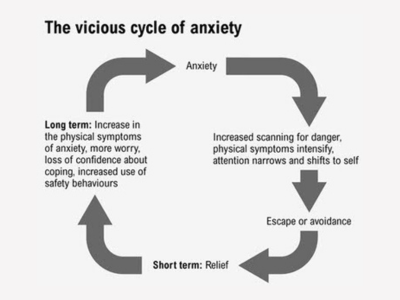
Anxiety might lead some people to avoid certain situations. For example, social anxiety might make people become isolated. A fear of flying can mean avoiding holidays. When the triggering situation is avoided, an immediate feeling of relief can happen, but this is short-lived. The more the situation causing the anxiety is avoided, the more anxiety we feel the next time the situation occurs. This is called the ‘anxiety/avoidance vicious circle’.
Anxiety can lead to phobias or other mental health issues.
When anxiety becomes very strong it can lead to a phobia of that thing. It could be someone feels anxious eating in public because once they became ill after eating in a public place. If they then avoid eating in public at all, they could develop a phobia about this, which could potentially lead to an eating disorder, or inhibit them from enjoying social activities.
Sometimes people feel anxious even when there are no specific triggers. They have a constant feeling of unease and anxiety and this can be very distressing especially if you do not know what has caused it.
What Helps With Anxiety
There are different strategies that can help reduce anxiety. If someone has a diagnosed anxiety disorder, for example Obsessive Compulsive Disorder (OCD) it is really important to get help from a professional experienced in this condition. You can go to your GP to seek help from someone experienced in your condition.
If your anxiety is more general but is still causing you distress you can look at some self-help techniques or you can find a Counsellor who can help you with your anxiety.
Self-Help Techniques for Anxiety:
The NHS has a really useful tool for supporting your anxiety it can be found here:
Finding Additional Support For Anxiety:
As discussed earlier, your GP can be a first point of access for any mental health difficulty including anxiety.
Or you can find a Counsellor who is experienced in working with anxiety.
Please reach out to me if you would like further information about how I can help you with anxiety or other difficulties you may have.